
Disruptive environmental activism (2023–2025) had mixed but mainly positive effects on UK public opinion

This post is co-authored by my collaborator and project leader Clara Vandeweerdt.
These are preliminary results from the most comprehensive study ever of the effects of disruptive environmental activism, via the mass media, on the UK public’s environment attitudes. We found every mainstream news article about a disruptive environmental protest in the two-year period up to October 2025. We selected 100 articles at random, with those more likely to be read (according to reader figures) more likely to be selected. Long articles were shortened by AI, and they included up to three pictures.
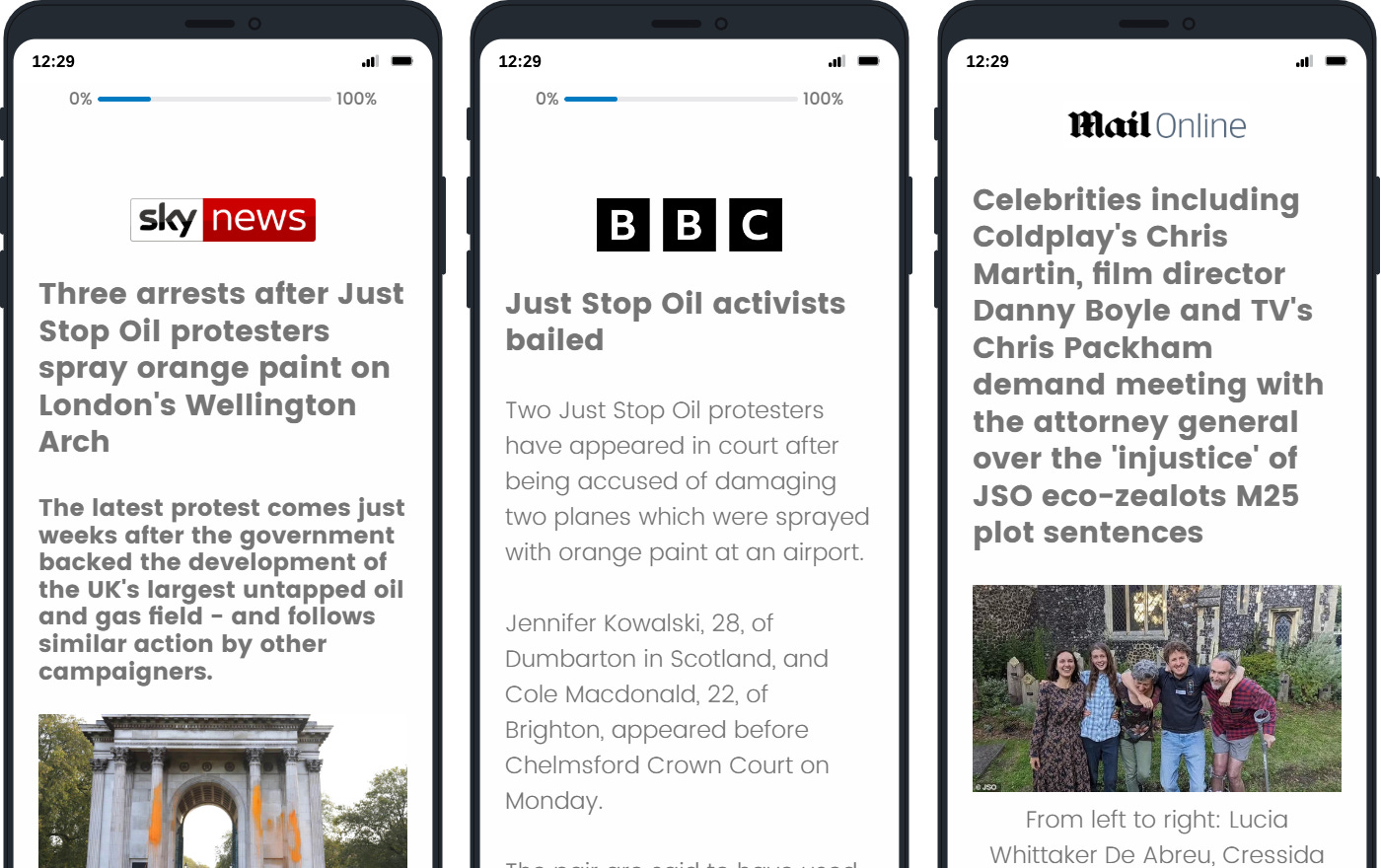
Three example articles as seen by participants
We tested adults quite representative of the UK population for age, gender, and political ideology. We showed each article to 26 people, and compared environmental attitudes between the 2573 people who had just read an article and 649 people who did not read an article. More details on this randomised controlled trial are in our study pre-registration.
Results outside the margin of error include:
Issue salience increased 📈. Mentioning the environment as one of the top problems facing the UK was increased by 13% in article readers (baseline was 13%).
Environmental policy support increased 📈. The proportion who on average supported three different key policies (such as phasing out the sale of new petrol and diesel vehicles by 2035) was increased by 3% in article readers (baseline was 47%).
Environmentalist identity reduced 📉. The proportion agreeing with “I see myself as an environmentalist” was reduced by 5% in article readers (baseline was 54%).
No measurable effects on concern about climate change or behavioural intentions.
Article details (what activists did and how it was reported) made few detectable differences. There are some low-confidence patterns, which we suggest readers interpret themselves.
Issue salience is easier to affect than other attitudes we measured – it fluctuates more. The positive impact on policy support and the negative impact on environmentalist identity are therefore probably more important. So, whether the last two-years-worth of such activism has been positive or negative probably depends on which is most important out of policy support and environmentalist identity (this is a less extreme example of the well-known activists’ dilemma).
Environmentalist identity can be an important predictor of pro-environmental action (classic article, recent review). Indeed, further analyses of our data showed that those who took a bigger hit to environmentalist identity showed less of an increase in policy support, and greater tendencies towards decreases in other measured attitudes. But in all cases, these appeared balanced out by other factors, so that there were no overall measured decreases.
Policy support probably matters more, and more directly. For example, this week the Conservative Party in the UK announced a departure from the previous political consensus of phasing out new petrol and diesel vehicles by 2035. Because of the last two years of disruptive activism, we can be quite confident that this regression will be slightly more costly for them than it would have been. It’s also likely that, in the context of reading articles about activists, our measurement of environmentalist identity tapped more into “I’m not like these environmentalists” than “I’m not someone who cares about the environment”, which is less problematic.
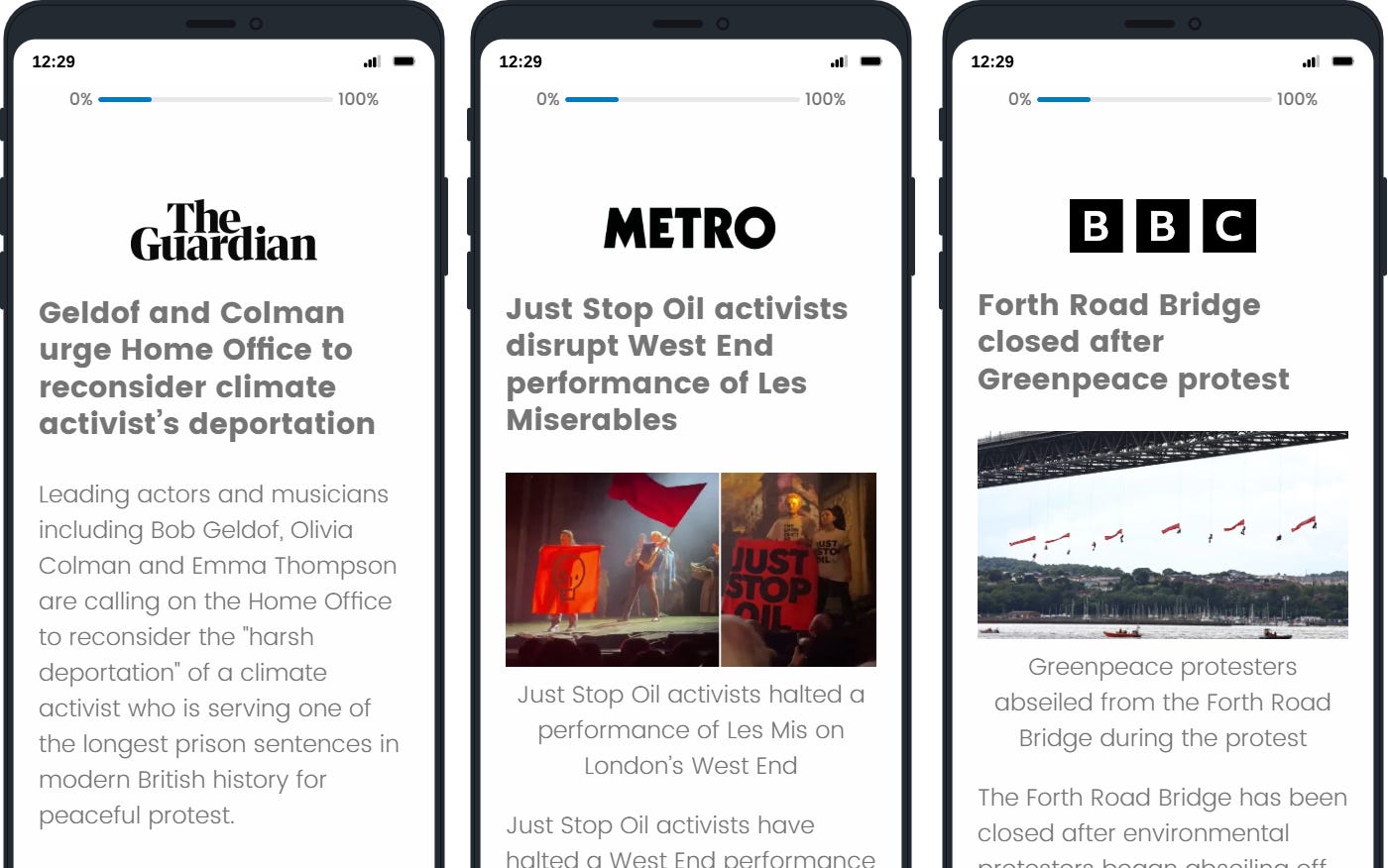
Three more example articles as seen by participants. The six articles included here were randomly chosen from the 100 - it is representative of the material that (1) Just Stop Oil dominates and (2) there is appreciable coverage of harsh legal measures.
The issue is not clear cut, and those planning action need to think very carefully, but we lean towards concluding that the impact on policy support was more important, and the activism was therefore probably overall beneficial. Because of the uncertainties, we ran a straw poll of twelve colleagues working in the area (eight with PhDs, the rest mainly PhD students): six leant towards agreeing that the policy support was more important, one towards that the environmentalist identity result was more important, and five thought the issue was too uncertain to call.
The main limitations of our study are that:
We don’t know how the results would be affected if we included video news or non-mainstream media such as social media.
The measured effects in our study are weak – but these are average effects on one person after reading one article. If each of those impacts is like one rain drop, what is the overall lasting effect of these drops? They might combine to form a river (the measured percentage changes are underestimates of long-term population effects), or perhaps each dries up before there is even a puddle (the reverse).
With regard to the size of the impact, one thing is very clear: it may be positive, but it is not enough. Other results tracking change over time show that although public attitudes remain, on average, strongly pro-environmental and more pro-environmental than most people think, the trends over this period have been in the wrong direction. Although disruptive environmental activism appears to have helped more than it hindered, it is not solving the problem, and the movement needs to keep innovating to find new solutions to pressure decisions makers.